
Listen on: Apple Podcasts | Spotify | Amazon Music | Stitcher
My all-time favorite song category are movement songs. Why? Because movement songs provide endless opportunities to engage children and can give them an opportunity to regulate their sensory systems.
What are movement songs, anyway? Movement songs are any type of song that has any kind of motion, gesture, or action in it. It can be simple movements such as moving your pinkies or your eyebrows, or it could be greater movements such as when children are up dancing, playing and getting their wiggles out.
When it comes to movement songs, I have a very systematic kind of approach. On this blog post and in episode 9 of the Music For Kiddos Podcast, I share my system and how I use movement songs in my classes and therapy sessions.
BTW, this week’s resource is a fun and engaging movement song called Scurry Stick, and you can download the chords + lyrics at the bottom of this page↓ Every month I sent out an original, professionally recorded children’s song for FREE to my newsletter subscribers, so if you want to receive original children’s songs every month to use with your kiddos, get on the list here.

Categorizing Movement Songs:
Three Distinct Types
I categorize movement songs into three different types: Active Movement Songs, Transitional Movement Songs, and Cool Down Movement Songs.
As I was thinking about how to present this topic, I was reflecting back on the first podcast episode where I discussed my philosophy, and how a lot of what I do has a sensory and regulatory lens. That same lens is applicable to my movement songs, also.
Interestingly, I hadn’t initially realized that the names I selected for my movement songs and the way that I categorize them has this sensory-based approach to it, but it absolutely does. So if you haven't listened to that episode, you might be interested in listening back to it because it kind of explains this overall approach and why I choose to use the songs that I choose.
The way that I label movement songs is based more on their function than anything else. For example, instead of simply referring to them as standing songs, dancing songs, sitting songs, or stretching songs, I categorize it by its function - active movement songs. So, here's a little bit about the three kinds.
Active Movement Songs
These songs are energetic that have the potential to elevate the heart rate of the child, clinician or teacher. I can't tell you how many times I've been winded by my own movement songs. Active movement songs might include jumping, dancing, stomping, wiggling, or any kind of big movement. Functionally, using an active movement song meets children at their energy level. Maybe you’ve identified that they are having a hard time paying attention and that they need some kind of active body break.
An example of an active movement song is “Move It Move It,” where participants are encouraged to move around quite a bit.
“Move It, Move It!”
Move it, move it
Let me see you move it, move it
Move it, move it, til I say stop
Now shake it up, shake it up, shake it up, shake it up yeah.....
Come on let’s move it, move it
Come on let’s move it, move it
Come on let’s move it, move it
Move it, move it, til I say STOP
Transitional Movement Songs
Transitional movement songs typically have more of a medium energy level, designed to start bringing the energy level down. It might be a sitting song, or one with smaller motor movements, such as wiggling shoulders or moving your head or elbows. Functionally, I use them immediately after something more active as we are transitioning to something else. My goal is to bring the child’s overall energy or arousal level down while still allowing them to move, which aids in regulating their sensory systems.
For me, these transitional movement songs tend to be highly structured. They have clear instructions in them with lots of starts and stops, and a very defined musical structure — all of those things help to sustain a child's attention. These elements help to sustain their attention in order to help them regulate down.
An example of a transitional movement song is my sitting movement song that I have called “Move to the Beat.” This is great for kids in a wheelchair and those who need to stay in their seats, while still allowing their bodies to move a little bit.
All of these movements are things that you can do from the waist up, engaging the shoulders, elbows, eyebrows, noses, and even hair. It maintains a medium energy level while encouraging movement and engagement.
“Move To the Beat”
Move to the beat
Move to the beat
Move to the beat
Move to the beat, now let’s
Move to the beat
Move to the beat
Move to the beat
Now get ready to STOP
(Clap your hands, move your shoulders, flap your wings, etc.)
Cool Down Movement Songs
The last kind of movement song is what I call a Cool Down movement song. These are characterized by their lower energy levels, often involving sitting or lying down, and incorporate things like deep breathing and yoga stretches. And functionally, I find myself using cool down movement songs near the end of a big group or maybe even in the middle of a session where we just had a little bit of struggle.
During these times, I employ a series of movement songs to guide them through:
An active movement song to get them moving
A transitional movement song to ease into the cool down phase
In theory, once we reach the cool down movement songs, participants should be ready to listen. These songs can be either very structured or very improvisational. I will give you an example of both a structured and an improvisational cool down movement song in a bit.
Structured Songs: Choosing a structured song might be best if you are struggling a little bit to grasp attention. The song I’ll share features clear counting, specific durations for stretching and yoga poses, and a clear cadence at the end. This structure is helpful if they are still a bit dysregulated and struggling to pay attention. That musical framework gives them very clear and specific instructions for how they should move their bodies.
Improvisational Songs: These are incredibly flexible and adaptable when performed live, and you can closely observe in the moment whether they require more structure or if they are completely relaxed with you. For example, in the first podcast episode and blog post, I shared a song called “Breathe.” It is a very simple song where the rhythm can be stretched out in a rubato manner, making it sound legato. Sometimes I throw in an extra section based on the group’s needs. You can assess their needs as you play, allowing space for either more structure or deeper relaxation. To go further into relaxation, you can really stretch out the notes with a rubato feeling, creating that space that’s like taking a breath and having a big release.
So, you have the ability in these cool down movement songs to be either structured, improvisational, or you can absolutely do both. My “Yoga Song” is very structured with predictable counting, but you will notice that I still kind of stretch out the notes a little bit, which helps maintain attention and gives them instruction on holding each yoga pose.
“Yoga Song”
1, 2 , 3, 4, 5, 6, 7, 8, 9, 10 Push up to DOG
1, 2 , 3, 4, 5, 6, 7, 8, 9, 10 Go down to CHILD’S POSE
1, 2 , 3, 4, 5, 6, 7, 8, 9, 10 Sit up to BUTTERFLY
1, 2 , 3, 4, 5, 6, 7, 8, 9, 10 Put your hands by your heart
1, 2 , 3, 4, 5, 6, 7, 8, 9, 10, 11, 12
Take a deep breath and rest.

Utilizing Movement Songs for Flexibility and Engagement
I sometimes use all three types of movement songs in a row, which can work really, really well. Other times, just an active movement song followed by a transitional one is enough, and a cool down song isn’t needed.
In really large groups, I choose active movement songs based on the energy level of the group at the time. Some of them have the tendency to bring the energy level up a lot, and some maintain a lower energy level. If I’m worried about an active movement song bringing the energy level up too much, I’ll do a transitional movement song. I might do two or three of those, and if the group responds well, I may go back to an active movement song, followed by a transitional then cool down movement song.
It’s all really flexible; I adapt based on the dynamics and needs of the group. Having a diverse toolbox full of different kinds of movement songs is so helpful. So, while there is a systematic approach, it is also really flexible. That is where I like to live in music - between structure and flexibility. I have structure if I need it and I have improvisation if I don’t, and there are very specific uses for both of those times.
Mini-Course: Movement Songs for Kiddos
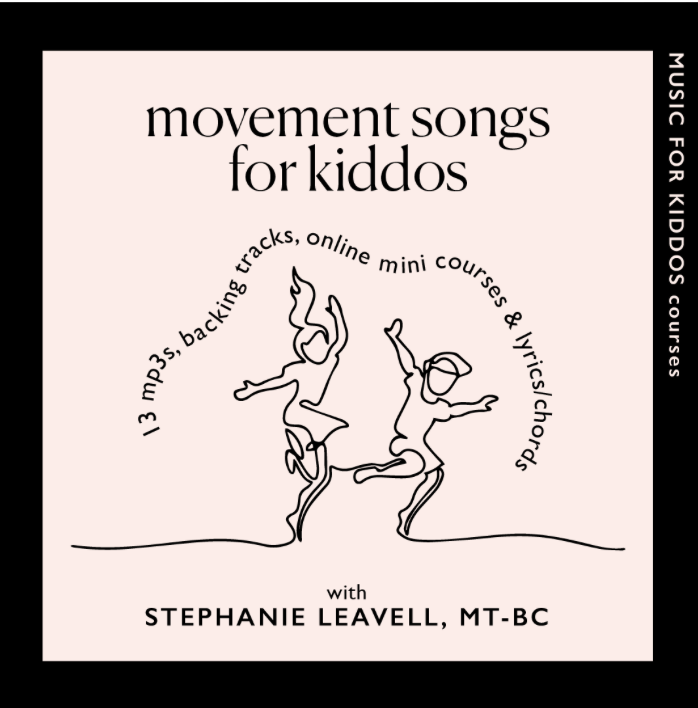
I really enjoy having options, and if you’re interested in more on movement songs, it’s a topic I could discuss all day long!
I actually have a mini course called Movement Songs for Kiddos. It features 13 movement songs in it, complete with professional recordings, backing tracks, plus the chords and the lyrics for each songs. Additionally, there’s a video that explains these three kinds of movement songs and how I might use them, as well as implementation tips for each one of them. It’s a quick course packed with value!
Use the code podcast on the Movement Songs For Kiddos course to get $10 off. Find the course here.
Sharing a New Movement Song: “Scurry Stick”
This song was inspired by a memorable visit to England a few years ago. My daughter and I were watching TV, and this amazing program came on. They were playing a fun tag game where the players scurried and stuck like geckos with sticky feet.
I like to use this song as part of a rainforest theme, and I have a rainforest lesson plan this song is in where we pretend to be geckos with sticky hands, scurrying and sticking. My students love this song, and it’s a great opportunity to talk about body awareness and respecting peers’ boundaries.
My favorite part of this song is the element of surprise—I vary the scurrying time to build anticipation for the moment we stick. You’ll hear it in the recording, too. It tends to hold their attention well, because they keep their eyes on me waiting for the stick!
Today’s resource:
🎵Download the lyrics + chords + mp3 of the song Scurry Stick here ↓
*and if you would like to receive the chords + lyrics + mp3 of original songs every month, subscribe to the Song-Of-The-Month Newsletter to get everything right in your inbox.
We have partnered with West Music to offer free shipping on orders above $59.95 to Music For Kiddos Podcast’s listeners. Check out their incredible instruments and their incredible offerings at WestMusic.com or you can place your order at their customer service hotline at (800) 397-9378.
The code for free shipping is KIDDOS26. Make sure to check them out!
Let’s keep in touch!
Song-of-the-Month Club (FREE!)
Thanks for tuning in!
Thanks for joining us on the Music for Kiddos podcast! If you enjoyed this episode, please head over to Apple Podcasts and tell us what you think by leaving a review! Don’t forget to sign up for the Song-of-the-Month-Club to receive a free, high-quality original song every month, or hang out with us on Instagram to stay connected.
This post contains affiliate links. As an Amazon Associate, I earn from qualifying purchases. I may receive a commission if you purchase through my links, at no extra cost to you. That being said, we only promote things we absolutely LOVE!