
Music For Kiddos Podcast
Listen on: Apple Podcasts | Spotify | Amazon Music | Stitcher
WHY THE UKULELE IS PERFECT FOR KIDS
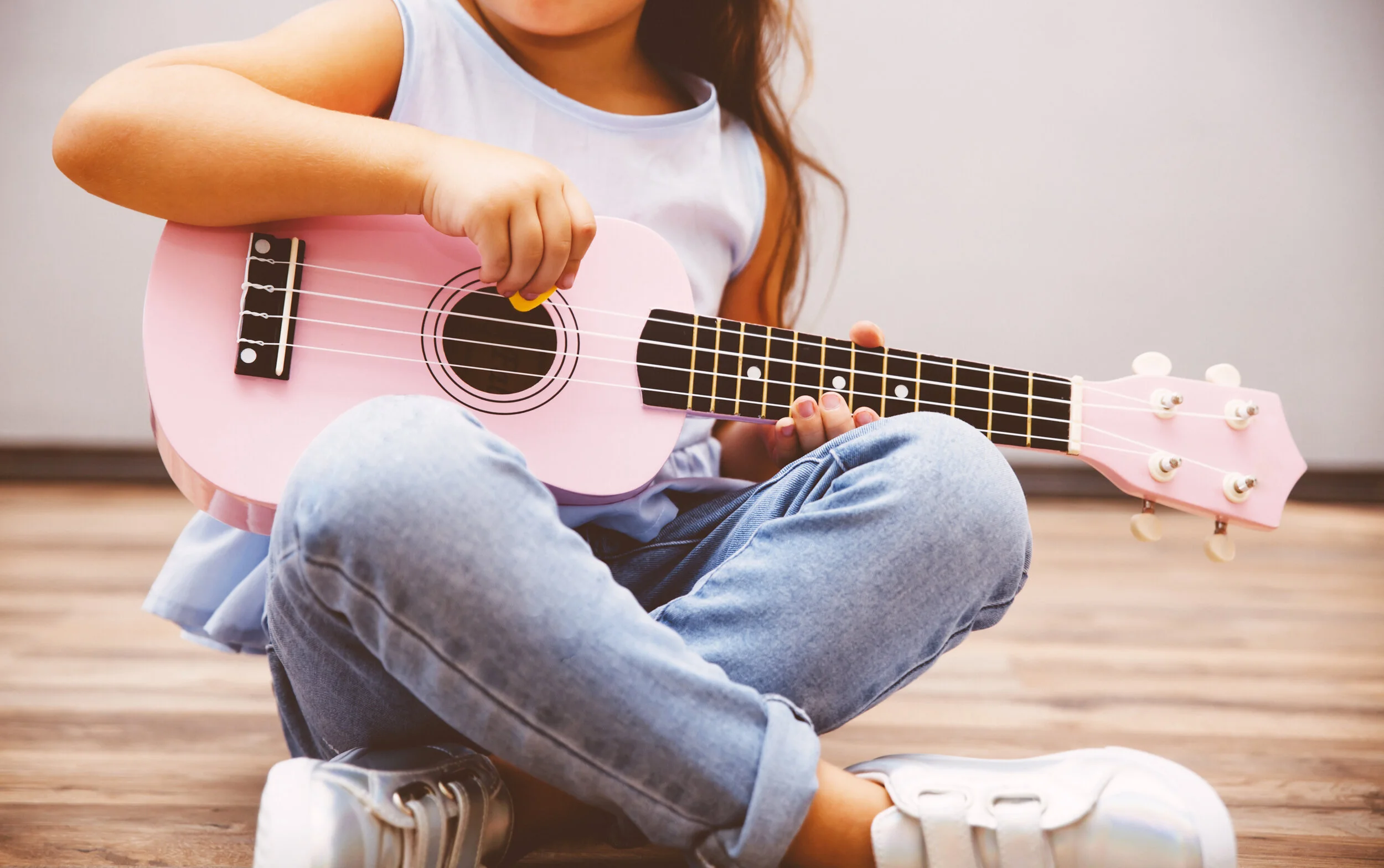
The ukulele is a favorite instrument of so many music therapists, music educators and parents, because it is very accessible to kids. You can hand the instrument to kids as young as four, and they can be playing a song. If kids are excited about playing the ukulele, if they are motivated, they can learn a song very, very quickly.
So, I’m going to give you my 10 best tips all about choosing a ukulele, teaching new and young learners of the ukulele, and supporting and motivating kids to learn quickly and eagerly. I’m also sharing with you the song, “It’s A Good Day” that you could teach to your students that are a little bit older or more advanced.

TIP #1: GET A QUALITY INSTRUMENT
I believe that it is very important to invest in a quality ukulele. You will definitely need it to stay in tune, and a quality instrument will be ready to go much better than one that isn’t.
Plan to spend at least $60 on a ukulele, but one of my favorite ones is the Kala Starter Pack on Amazon for $75. This is actually the one I use almost every day.
Any ukulele will need to be tuned several times at first, but once you get it past that “initiation tuning,” you should be able to pick it up and expect it to still be in tune—and that is going to be at least a $40 ukulele.
TIP #2: COLOR CODE THE CHORDS ON THE UKULELE
Color coding the chords for kids is going to help them be able to actually play something much quicker. You can do this with metallic sharpies (it removes with acetone) or with teeny, tiny colored dot stickers. Either way, color code the chords directly onto the neck of the ukulele.
If kids can start playing something soon, they will want to keep playing—and our primary goal is for them to enjoy playing the ukulele and to foster that love of music.
TIP #3: INTRODUCE THE CHORDS SLOWLY
Make sure that when you are introducing new songs, it should be something they can play almost immediately—but just a teeny, tiny bit harder than what they could do previously. Use the same chord(s), but add in something more difficult like a different strum pattern. We don’t want to stack on too many things at once for an early learner.
I have created a curriculum for ukulele that is primarily based on this concept of introducing the chords slowly.
TIP #4: TUNE THE UKULELE FOR THEM
Tuning can be frustrating, especially for younger kids. So, my tip for you is to go ahead and tune the ukulele for them. They can learn how to tune it themselves eventually, but that “initiation tuning” takes 10 to 15 times for it to really stay in tune. Go ahead and do that for them so that they don’t even have the opportunity to get frustrated.
TIP #5: USE WORDS AND NUMBERS FOR CUEING
Musical structure, like “1, 2, 3, 4, 1, 2, 3, 4” is not intuitive to most kids, so they can’t always internalize that when they are just starting out. So instead, I look for cues right in the songs that gives them a shortcut to cue a chord change.
My favorite song to teach kids on the ukulele is “Apples and Bananas.” I love it because the only time in the whole entire song that a chord change happens is on the word “bananas.” It switches back and forth between the F and C7 chord—every time “bananas” is sung and only on that word.
They are learning something brand new, so give them a little bit of a shortcut by giving them that little cue. This removes the added difficulty that comes with stacking a bunch of new skills, one on top of the other.
I realize that not everybody has this approach, and that is totally fine. I think this is a little bit of the music therapist in me that desires to get them straight to playing before I worry about the theory and things like that, especially for the young and early learners.

TIP #6: USE SUCCESS-BASED PHRASES
In my internship at Massachusetts General Hospital with Lorrie Kubicek, she had this brilliant, simple little phrase she would use when she was teaching kids how to play the ukulele and the guitar. When the kids would get that “clunk” sound because they weren’t pushing on the strings quite hard enough, she would say, “Wiggle your finger and push a little bit harder.”
If you tell a kid to “push harder,” they might get frustrated and say something like,” I’m already pushing it as hard as I can!” If you tell them to wiggle their finger, that really helps, right? But then, push it down a little bit harder.
So that phrase, “Wiggle your finger and push a little bit harder,” I feel is a really success-based way to help kids get a good tone out of the ukulele.
TIP #7: DON’T MAKE LESSONS TOO LONG
A really important tip is: don't make your lessons too long. Whenever you see a point of frustration, help them through it - but don’t exceed that point - and end with something that they are successful doing. They are much more likely to pick up a ukulele again this way.
TIP #8: FOCUS ON THE SONGS THAT THEY’RE EXCITED ABOUT
In music therapy, we talk so much about preferred music. Research shows that utilizing a client’s preferred music is going to be significantly more beneficial and much more likely for music therapy to work for them. It has to be preferred and individualized.
So, I like to apply that to learning to play the ukulele, too. Make sure the kids are getting songs that they are excited about.

TIP #9: CONSIDER HOW YOU ARE GIVING INSTRUCTIONS
This tip is all about considering how you cue and give instructions. With the ukulele, we have an opportunity for three different kinds of cues.
Verbal: “Play string one”
Visual: Pointing to string one
Vocal: Singing “ah” to match the pitch of string one
Each kid is going to respond very differently to these. As a child, I would have responded really well to the sound of the string by ear. But just the sound alone really isn’t as effective as if we start stacking these. Let’s think about stacking the verbal and visual cue—so, you would point to string one while verbalizing, “play string one.”
I’ve found that with kids, it’s best if I stack all three of these cues together, like this: Sing, “Play string one” on the pitch while also pointing to string one.
This way, I increase the chances of success for a child understanding what I am communicating to them. I might have a visual, verbal, and vocal learner all in the same group—and by stacking these cues, I’m increasing their chances for success.
TIP #10: LEAVE THE UKULELE ACCESSIBLE
My last tip for you is to really leave the ukulele accessible. Leave it on the couch, leave it tuned—just leave it available so that kids can grab it and play it at any time. Make sure, if you have younger kids, to get one that you don't mind being a little bit beat up. But, I think it's okay if they beat it up a little bit, as long as they're exploring it and playing it.
FREE RESOURCE:
The song “It’s a Good Day.”
This is actually the opening song of the Music For Kiddos Podcast!
🎵 Download the chords and lyrics of “It’s A Good Day” here ↓
Are you looking for a simple, step-by-step guide on how to teach children the ukulele?

Our online course + workbook “Ukulele For Kiddos” is a simple how-to guide and method for teaching ukulele to kids ages 4-10.
With this online course and PDF workbook, you will get:
A simple method for teaching ukulele to kids ages 4-10
12 mini video lessons + a 20-page PDF workbook
Color-coded chords with gradually increasing difficultly featuring 16 simple songs
Step-by-step success-based implementation
Prerequisites: None! ZERO experience needed.
With this online course and printable PDF guide, you’re getting the equivalent of 12 weekly lessons AND a beginning ukulele book. (P.S. You’d spend more on a single private lesson!)
The Music For Kiddos Podcast has partnered with West Music to offer free shipping on orders above $59.95 to Music For Kiddos Podcast’s listeners. Check out their incredible instruments and their incredible offerings at WestMusic.com or you can place your order at their customer service hotline at (800) 397-9378.
The code for free shipping is KIDDOS26. Make sure to check them out!
Let’s keep in touch!
This post contains affiliate links. As an Amazon Associate, I earn from qualifying purchases. I may receive a commission if you purchase through my links, at no extra cost to you. That being said, we only promote things we absolutely LOVE!